
-
Getting Started
-
Introduction to Administrative Health Data6 Topics1 Quiz
-
Sources and Types of Administrative Data8 Topics1 Quiz
-
Accessing Information on Drugs, Diagnoses, and Procedures7 Topics2 Quizzes
-
Strengths and Limitations of Administrative Health Data8 Topics1 Quiz
-
Data Privacy, Access, and Security8 Topics1 Quiz
-
References
-
Additional Resources


Who collects administrative data?
Data are collected by healthcare providers and institutions during the provision of health services. We define healthcare institutions as facilities where health services are provided, such as hospitals, outpatient clinics, emergency departments, and pharmacies. Each patient encounter with the healthcare system generates a new record.
Who stores administrative data?
Healthcare providers, institutions, and government organizations are health information custodians (or data custodians) that are responsible for collecting and storing personal health information.[5] Generally, administrative health data are stored at jurisdictional level and in some cases at the federal level. At the jurisdictional level, data are stored by a Ministry of Health and/or the regional health authorities of a province or territory. These data are incorporated into a jurisdiction’s data holdings (i.e., a repository of linkable administrative data sets) and each jurisdiction governs the availability of data for research through regulatory standards. In addition, some independent non-profit or university-based organizations hold data repositories through partnerships with health information custodians for the purpose of facilitating health research. Examples include the Institute of Clinical Evaluative Sciences (ICES) in Ontario, Population Data BC in British Columbia, and the Manitoba Centre for Health Policy.[6-8]
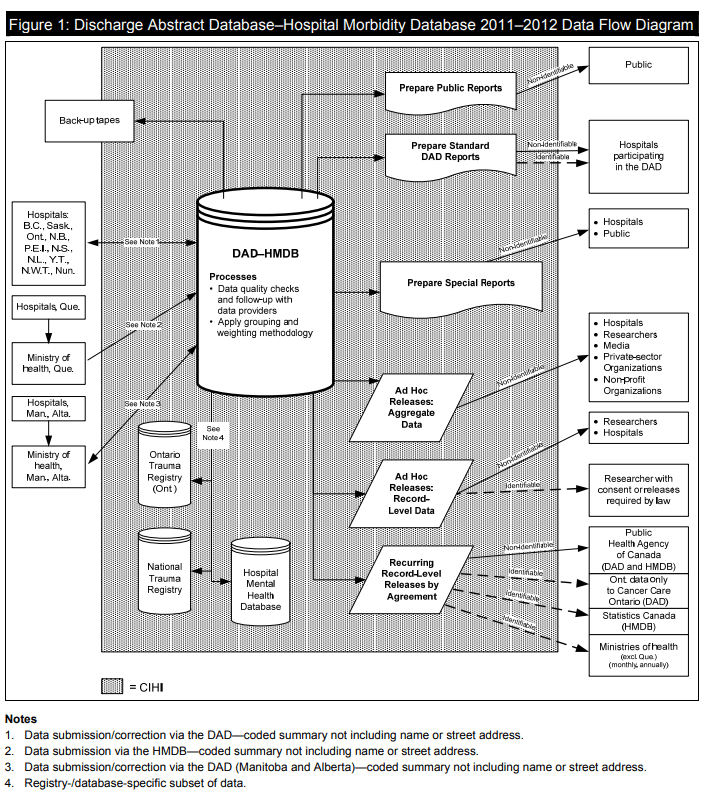
Certain sources of administrative data are also stored at the federal level by the Canadian Institute for Health Information (CIHI). For example, all acute care hospitals in Canada (except Québec) are required by their jurisdiction’s Ministry of Health to submit hospital data to CIHI (Figure 1).[9] These records are incorporated into the CIHI Discharge Abstract Database (DAD), where they undergo data quality control processes. A compiled jurisdictional data set is then released to the provinces/territories on either a monthly or annual basis, depending on the jurisdiction.[9,10] Similarly, some provinces require emergency departments to report data to CIHI on hospital- and community-based emergency and ambulatory care visits. These records are incorporated into the CIHI National Ambulatory Care Reporting System (NACRS) and are released to the provinces on a regular basis.
Inter-provincial differences
It’s important to note that while provinces share commonalities in the information captured in their administrative health databases, variations exist in data collection, reporting, and coding systems across provinces.[1] This is especially true for physician services and prescription drug claims databases. We’ll discuss this further in Section 2: Sources and Types of Administrative Data.