

Case-control analyses
Case-control analyses represent another common type of observational study, although they may be viewed as modified cohort studies which sample from rather than enumerate all individuals from the source population.4 While a cohort study compares exposed and unexposed individuals with respect to incidence of a disease, a case-control analysis compares cases (individuals with the disease) to controls (individuals without the disease) with respect to their exposure status.1 All cases from the source population may be used, but controls consist of a sample from the source population. Importantly, controls are sampled independently of exposure status.4 Case-control studies allow for estimating an odds ratio, but depending on the sampling strategy the odds ratio may be equivalent to a rate ratio or risk ratio (as described below).4
One type of case-control analysis is the nested-case control study.1,4 This design was used in a study of higher versus lower potency statins and new onset diabetes.22 (A modified version of the protocol for this study is available as part of these training modules.) The source population consisted of patients recently discharged from hospital following a major cardiovascular event or procedure who were then newly prescribed a statin. Cases were patients diagnosed with diabetes within the study period. For each case in the study, controls were randomly selected from among the subset of the study population who were still at risk of diabetes at the time the case was diagnosed with diabetes. This study found that higher potency statins were associated with a higher risk of new onset diabetes as reflected in a rate ratio of 1.15.
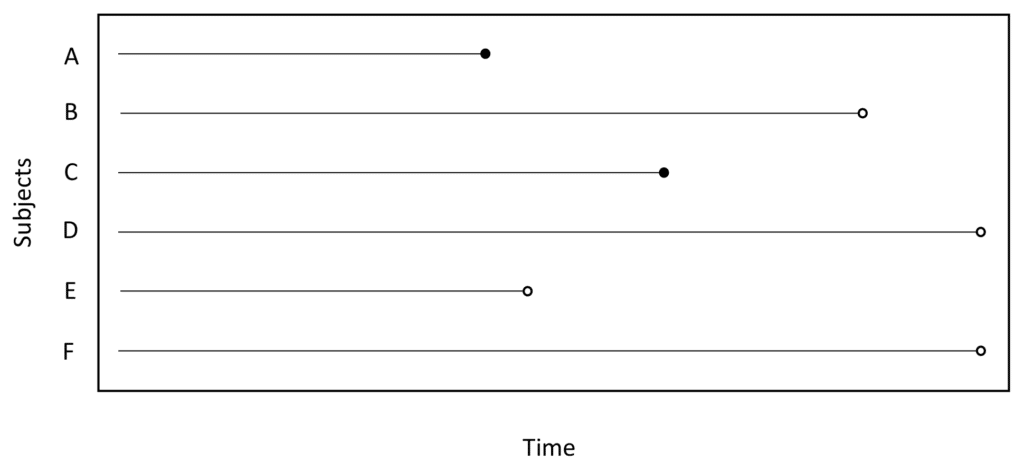
The method of sampling controls just described is referred to as risk-set sampling. When this approach is used, the odds ratio estimated is equivalent to a rate ratio.4 Figure 3 shows subjects from a hypothetical nested-case control study using risk-set sampling. When subject A experiences an event and becomes a case, controls may be randomly sampled from a risk set of other subjects who are at risk of an event on A’s event date, i.e., subjects B, C, D, E, and F. Similarly, when subject C experiences an event and becomes a case, controls may be sampled from a risk set including subjects B, D, and F.
Figure 3. Hypothetical nested case-control study involving 6 subjects (solid dots denote events, i.e., incident disease, while circles indicate end of follow-up without an event)
Another type of case-control analysis is the case-cohort study.1,4 In this type of study, controls are randomly sampled from all members of the source population at baseline.4 As each control represents a fraction of the total source population rather than person-time, an odds ratio estimated using this study approach will be equivalent to a risk ratio rather than a rate ratio.4
Notably, with either a nested case-control design or a case-cohort design, controls may also be cases in the study. In the nested case-control study, an individual who serves as a control for a case at one point in time, may later develop the disease studied (e.g., diabetes) and serve as a case. In a case-cohort study, it is useful to think of controls as sampled at the start of follow-up when all individuals are free of the disease, while some will later become cases.4
We can draw a comparison with methods for analyzing clinical trial data. While a cohort study which determines exposure status at cohort entry may be viewed as using an intention-to-treat approach, a case-control analysis may be viewed as using an as-treated approach because exposure is assessed preceding the date of diagnosis (for cases) or a corresponding index date (for controls).