

Incidence rate
Another way to express incidence is through an incidence rate. An incident rate may be calculated as: Incidence rate=A/Time, where A is the number of subjects developing a disease (or experiencing an event) and Time is the total time that subjects are followed.4 The denominator in this formula may be understood as the time at risk of the disease or event of interest. When calculating an incidence rate rather than an incidence proportion, we are explicitly including follow-up time in our calculation.
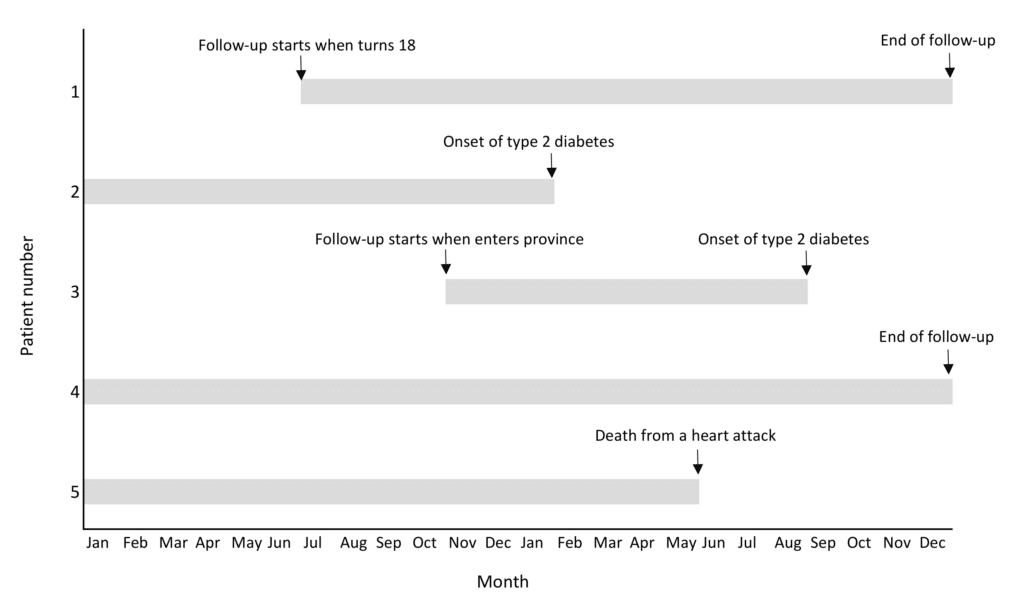
Let’s say that we were interested in calculating an incidence rate for type 2 diabetes using data from a two-year period for adults residing in a given province. During that period, some would turn 18 (used as a definition for adults in this case), some people would enter the province, others would leave the province, and some would die of other causes before the end of two years. A simple diagram of follow-up for a small sample of patients is depicted in Figure 1. The diagram shows that some patients would be followed for two years (patient 4 in Figure 1) while others are followed for a fraction of that time (patients 1, 2, 3, and 5 in Figure 1).
Figure 1. Diagram of a hypothetical sample of residents age 18 years and older followed to measure onset of type 2 diabetes over a 24-month period
Continuing with our hypothetical example, we find that 15,000 new cases of type 2 diabetes are recorded. Totalling follow-up time across all individuals followed results in 2.5 million person-years of follow-up time overall. The incidence rate of type 2 diabetes is 15,000 cases/2,500,000 person-years, or 6 cases per 1,000 person years. Depending on the events being studied, the researcher may choose to express a rate according to events per person-month, person-year, or other unit of person-time. While a rate may be more difficult to interpret than risk, in many cases it is more appropriate because it can more easily account for a subject’s time at risk.
While it is beyond the scope of this introduction to epidemiologic measures, survival analysis is a method of estimating risk over a period of time with changing incidence rates.4 You’ll find that many introductory texts in epidemiology will describe approaches to using survival analysis.1,4,10