-
Getting Started
-
Background1 Topic
-
Introduction to Propensity Scores2 Topics2 Quizzes
-
Estimating and Assessing the Propensity Score4 Topics
-
Applying the Propensity Score5 Topics
-
High-Dimensional Propensity Scores2 Topics
-
Applying the High-Dimensional Propensity Score3 Topics
-
References
-
Additional Resources

Cohort trimming
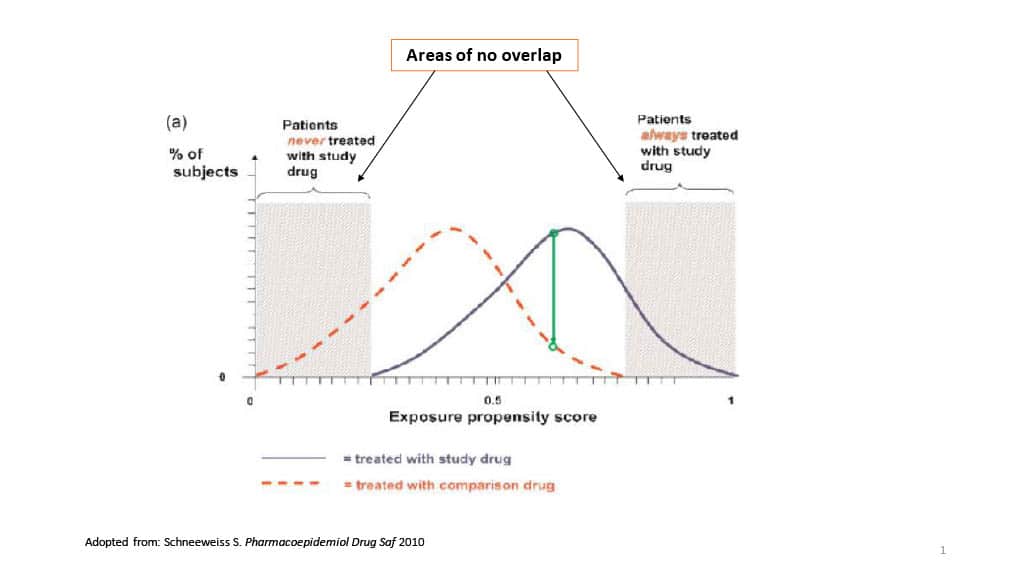
Cohort trimming refers to excluding individuals with extremely high or low propensity scores (individuals treated contrary to prediction) – for example, those with an absolute indication to a treatment but WERE NOT treated, or those with an absolute contraindication to a treatment but WERE treated. This is usually performed according to the percentile of propensity score in treated individuals at the lower end and in untreated individuals at the upper end to remove the areas of non-overlap. A simulation study showed that propensity score trimming reduced bias due to unmeasured confounders and mean squared error.7 While trimming is a valuable tool to perform before applying some propensity score methods such as IPTW and regression adjustment, it’s not required for propensity score matching as the cohort will be trimmed by design.7
For further information about cohort trimming, read the article below.7
PS distribution – areas of no overlap